POWER SKATER
The Story Behind It
Every day, we use hundreds of everyday products. The better they are designed, the less we notice them — and the more effort inventors and manufacturers have invested in creating them. Have you ever wondered who invented the ballpoint pen, the cordless phone, or the bank card? Behind every familiar object, there are always inventors who once devoted their talent, time, and creativity to a single idea.
The story of the POWER SKATER trainer is also a long journey of ideas, experiments, and innovation brought to life by dedicated inventors. This page is devoted to them.
We have found more than twenty patents related to the invention of the POWER SKATER trainer. Below, we highlight just some of them.
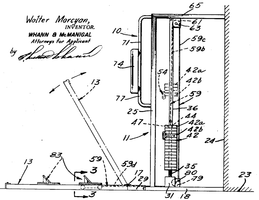
Walter Marcyan
Patent US3627315 от 26 ноября 1968 г.
This is the earliest patent for the invention that we were able to find. The training machine was designed to develop the leg muscles of athletes involved in contact sports, as well as sprint runners. The sliding platforms (marked as number 83 in the illustration) moved parallel to each other, while the resistance was adjusted by lifting weights through a cable system. The athlete leaned against padded supports (74) to maintain balance and apply greater force to the platforms.
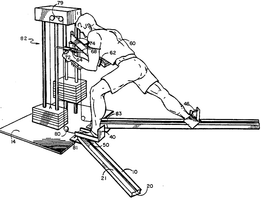
Patrick J. McCormack
U.S. Patent US4781372, dated April 15, 1987
This training machine is very similar to modern designs. Resistance was still adjusted by lifting different numbers of metal weights, since durable elastic bands were not yet available at the time. The key innovation of this machine was the ability to set the guide rails at different angles, making it suitable not only for runners, but also for hockey players, who require a right angle between the guides. The athlete’s foot was not rigidly fixed, but rested on a solid platform with multiple degrees of freedom. This also made it possible to point the toe at the end of the push-off movement.
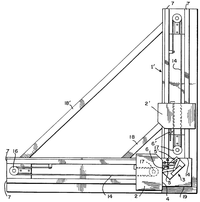
Ron C. Bulloch
U.S. Patent US006042511A, dated July 7, 1998
The training machine that can now be found on the market from our colleagues was developed by Ron C. Bulloch to train his son. You can learn more about the inventor by following the links below:
rcbulloch
The History of POWER SKATER
In this version, the guide rails are fixed strictly at a right angle. The machine is equipped with a mechanism that locks the sliding platforms in the starting position, while the resistance is adjusted by changing the tension of elastic bands. The result was a compact training machine, as it no longer required heavy weights or the mechanisms used to secure them.
We wish Ron C. Bulloch good health, continued creativity, and many more years of life.
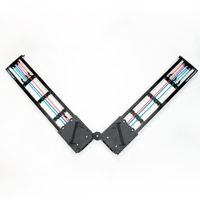
Power & Skater by YES-T
The POWER & SKATER concept continues to evolve, and we are proud to carry this idea forward. A development team led by Alexander Yesin has created its own version of the POWER & SKATER trainer, with a design that significantly expands the range of exercises for developing skating skills and strengthening the legs.
Today, we are working on the next generation of the trainer. We have succeeded in reducing its weight, adding mechanisms that make it more convenient to use, and expanding the range of resistance adjustments. We are also conducting scientific research aimed at developing individualized training programs for each athlete.